Showing posts with label Pearl Harbor. Show all posts

Tuesday, March 4, 2025

Sgt. Fury and His Howling Commandos #101

If you ever wondered how such a mish-mash of lunatics get paired together to become the Howlers, this is the issue you've been waiting for. If you thought it was all because of selective service randomly drafting recruits for the war effort, I don't think you really understand the Marvel Way of storytelling. Sure, most of these guys got drafted into the Army. A couple volunteered to fight. However, the way the unit came together was a story of fate, heroics and teamwork.

I thought it was a very good story. However, a couple of things seemed a bit far fetched to me. For example, my favorite Howler, Dum Dum Dugan, was a strongman in a European travelling circus when he met Fury and his CO, 'Happy' Sam Sawyer. Because of how well they worked together, Dugan was put in Fury's outfit upon request. Would that sort of placement been allowed back in 1942? I've glossed over how Dugan's trademark bowler isn't GI. But could just anyone say 'that guy has moxie. Enlist him. Then put him in my platoon!' 

While all of the Howlers appear here, in all honesty, this story is more about how the Fury/Dugan team came about. It's also about Nick's good friend Red Hargrove, whose death during the attack on Pearl Harbor inspired Fury to become a commando. 

Reprinting issue #34 of the series, this issue is a bit of a rarity as it's the first half of a 2-parter. Most issues up to this point have been stand alone. With 1 or 2 exceptions. It's possible that we get more of the Howler's origin in the following issue. Hopefully, the origins of Dino, Izzy and especially my next favorite Howler, Gabe, will be presented in the next issue giving those hardworking grunts their just due!

Worth Consuming!

Rating: 8 out of 10 stars.


Monday, January 14, 2019

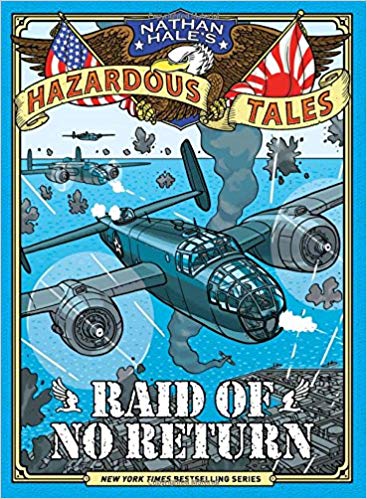
Nathan Hale's Hazardous Tales: Raid of No Return


The opening salvos of the Pacific Theater are explored in this World War II themed edition of Nathan Hale's Hazardous Tales. 

I love these books. They really explore aspects of American and World history that I thought I knew. And boy was I so wrong! 

With stunning aerial pictures of the attack on Pearl Harbor and the progression of both the Japanese and American naval fleets in the Pacific Ocean, this is the best rendered book of the entire series. 

Another key to this book being so good is that it's inspired me to want to read more. I knew very little of Jimmy Doolittle's raid of Tokyo. The stunt flyer turned colonel helped to inspire the American people to join the war effort with only 16 bombers! By deciding to focus on each plane individually, the author really personalized this small part of American history and I want to learn more!

Also, thanks to a great bibliography in the back of the book, I've got several other WWII books on my to-read list!

A must read for youngsters interested in the second world war. There is some mild swears in this book. And since it's a book about war, there will be some violence and death. What, did you expect the author to have everyone licked upon by kittens?

Recommended for ages 8-12. though I think readers as old as 14 might truly enjoy this book.

Worth Consuming!

Rating: 10 out of 10 stars.

Sunday, December 28, 2014

Gaijin: American Prisoner of War

This graphic novel from 2014 recounts the internment of Japanese Americans after the bombing of Pearl Harbor. The story is about a half-Japanese boy named Koji, who is forced into a prisoner of war camp on the suspicion of his father, who's visiting his ailing father in Japan, of being a spy for the Imperial Japanese. Not willing to allow her preteen son stay in a prison camp by himself, Koji's white American mother joins the internment camp as well.

   On the streets of San Francisco, Koji is viewed as the enemy and a possible spy or enemy agent of the Japanese. In the camp, Koji is also an outsider, particularly amongst the teen boys because of his mixed heritage. Koji is bullied, his mother is accused of being a whore, and the commander of the camp sees him as a trouble maker. With the help of a wise elderly Japanese man, Koji is given one last chance to find himself. But when the detention site is forced to move from the shipyards of Alameda to the New Mexican desert, Koji must decide to run from himself and flee with some of the boys in the camp or to finally make peace with his jumbled status, accepting his incarceration and transfer East with his mother.

    The setting of this story is 100% true. During World War II, Japanese Americans along the West Coast of the United States were forced to leave their jobs and home and were imprisoned in about a dozen camps nationwide. The camps were converted barns, with manure and filth everywhere or makeshift barracks hastily and dangerously erected. These sites were overcrowded and there was not enough food, provisions or decent care for the hundreds and thousands of prisoners encamped. Reports have said that a hardened prisoner at Alcatraz in 1942 had it better than the American POWS whose only wrong was their nationality or heritage.

   You might think with the prejudices Koji experienced in San Francisco, maybe the internment camps were for the good and safety of the Japanese Americans. But with very little choice, these families were left with no win solutions. They had to sell or rent their possessions and property and suspend their livelihoods.  After the war, some families would return to their homes only to find that the unscruplous whites that they trusted their estates to sold them off or claimed legal but unethical squattership. So much for looking out for the safety of our fellow man...

     As for Koji and his mother- they are fictional characters but they are based on the exploits of artist and writer Matt Faulkner's great aunt. She was a white American married to a Japanese man. The two had a daughter who by December 7th, had a daughter as well. Not willing to see her daughter and granddaughter detained, Faulkner's aunt went into the prison camps with them until eventually finding sponsorship for the family to move to Chicago under parole conditions.

   The story of the Japanese American internment is sadly a forgotten part of American history. I don't recall ever learning about it in school or college and I was a History Major. It wasn't until I saw the 1999 film 'Snow Falling On Cedars' that I even learned of the plight of the Japanese American during World War II. I learned about the Dust Bowl- a lot! Why not this?

   It may not seem like a very important part of American history. But not 15 years ago, we almost repeated history when such camps were suggested after the events of 9/11. Thank God we didn't listen to those voices calling from the desert again.

    Gaijin is a dynamic story that left me speechless. It should be required reading in schools. I wish had a couple million dollars because I'd snatch the rights to this book up and make it into a feature film. It's that good and that important to not just American history but to the survival of the human race as well.

    Worth Consuming

   Rating: 10 out of 10 stars.