Showing posts with label food. Show all posts

Thursday, July 23, 2026

America the Edible: A Hungry History, from Sea to Dining Sea by Adam Richman

Written in 2010, Adam Richman was riding high as the host of Man V. Food. The Travel Channel series saw Richman going to various cities, exploring the food culture. He'd close out each episode by going to an eatery that boasted a ridiculous food eating challenge. I remember on our first anniversary, I ate a 64 oz Sundae in less than 10 minutes. Unfortunately, you didn't get it free unless you finished it in 4 minutes or less. But hopefully, you get the picture of what Adam Richman was doing.

This book isn't tied into his Travel Channel travels. However, Richman does go on to review the culture and history of almost a dozen cities in the United States. Being July and the sesquicentennial, this seemed like an appropriate read. Cleveland, Ohio, Austin, Texas, and Savannah Georgia are some of the foodie destinations Richman explores. Only St. Louis, Missouri and Brooklyn were the places that the author chronicles that I have been to. So I learned a lot. Plus I made notes of places to check out the next time I travel to the Show Me State to visit my wife's family. 

Before Man V. Food, Adam Richman was a struggling actor either trying to survive in Hollywood or travelling the nation as part of a theater troupe. In those cities, he made notes of the eateries he had listed as well as the various tours of food markets and manufacturing. As an actor, its a common practice to give recommendations to other thespians when they are in a city for their next acting gig. Plus, being on the road can feel like a blur, so Richman would journal of the places he visited, and take pictures, in order to keep memories both good and bad. When it came to the bad, there was usually a woman involved.

I like Adam Richman now. He's really insightful and funny on shoes like The Foods That Built America and Hazardous History with Henry Winkler. But during his stint on MVF, I could take him or leave him. I liked his tour guide persona at the beginning of the show. His Jewish Michael Jordan persona when he would partake in during the food competition parts of the show, not so much... This book reflects Richman as a struggling, young actor. He was also kind of a slut. 

In every city, he's got a girl that he's either in a doomed relationship with or he's hooking up with or failing misery despite giving it everything he's got. There's a fair amount of sex. Thankfully, it's not raunchy, locker room accounts of his conquests. And I will admit, he's got charisma. But it's really annoying. 

I also don't understand the whole sexy food culture. Being in the culinary industry for nigh 21 years, I have never understood it. I'm more of an addict than a lover. But Richman gets down right orgasmic with the food. I do commend that when he finds a meal that was lackluster, he doesn't hold back. I critique the food I eat too. But having taught culinary high schoolers and college students, I'm a bit more forgiving when it comes to poor service and mistakes as long as you don't try to kill me by not properly addressing my food allergy when I ask if celery seeds are in the cole slaw 

Like I said earlier, I learned a lot about each city. Though the 3rd through about the 6th page of every chapter read like a student's report on major city. The climate. The natural resources. The breakdown of the ethnic population. I felt like I was grading my Culinary II students annual projects on Popular American Soups. It's not Richman's fault. He does a good job. It's just those sections felt very familiar to me...

This book is 16 years old. Richman, I see, has been happily married for about 3 years now. While hosting MVF, he gained nearly a 100 pounds. Famously, he quit the show to take better care of himself. He has probably matured lots as he got older. It was just a shock to see how candid he gets about food, travel, acting, his love life... It's like seeing your high school math teacher in public somewhere. It's awkward. And it's not something I can add to my office bookshelf for my students to borrow. 

I'll probably keep it until Christmas. That's when we're supposed to go to St. Louis. It'll be interesting to see if some of the places he ate at 20 years ago are still there. And you better believe, I'll be getting some Imo's pizza when I am there. It's amazing stuff with a unique, creamy cheese calld Provel and something of which both Richman and myself can agree.

Rating: 6 out of 10 stars.

Tuesday, March 31, 2026

How to Eat a Lobster and Other Edible Enigmas Explained by Ashley Blom

The culinary arts are chock full of conundrums. How do you crack open a lobster in order to get the maximum amount of meat from inside? Is it possible to eat an artichoke without getting those eternally dry thistles stuck in your throat? Which fork do you use for the salad course? Can you prepare yourself to eat demonically spicy food when in reality, you've got the palette of an iceberg?

Food Blogger Ashley Blom explores dozens of mysteries that have dominated kitchens and dinner tables for centuries. This is a book I wish I had years ago. I recall a demo I did for my culinary students that used a technique that I learned in culinary school involving opening a coconut. The established way had me using the hilt of a very sharp chef's knife and bringing it down in force atop one of the fruit's trio of eyes. The blade ended up cracking off the handle and shooting about 10 feet across the lab. While quite comical, it could have ended disastrously if the blade impaled one of my students. Needless to say, I haven't conducted a coconut demo since. Now thanks to another possible method brought forth from this book, I'm willing to give the coconut another go!

A very short read, both in size and length, this 2017 guide from Quirk Books would make a great gift for the foodie in your life. Pair it with a bottle of wine and you've got an exquisite house warming gift. Add a portrait of Ulysses Grant or Ben Franklin inside and you've got an informative graduation gift that might help bring another lost soul into the world of food and fine dining. Just overlook the millennial slang peppered throughout these pages.

Featuring tips for food prep, table etiquette and how to interact properly when challenges arrive dining out or as a dinner party guest, this should be required reading. Everybody eats. But not everyone knows just how to do it. I've been in the culinary industry for nearly 2 decades and I learned new tips and tricks here. This is definitely going to be a reference book for me to use in my culinary lesson plans. 

Worth Consuming!

Rating: 9 out of 10 stars.


Wednesday, February 4, 2026

The Incredible Story of Cooking: From Prehistory to Today 500,000 Years of Adventure (2026 Comic Book & Graphic Novel Reading Challenge)

It's impossible to cover all aspects of over a half million years of cooking in less than 215 pages of comics. But writer Benoist Simmat and artist Stephane Douay do a decent job. Originally published in French, this book focuses mostly on the contribution of France to the culinary arts. Being a culinary graduate, I had wondered like many other culinary students why French cuisine is considered the fundamental region of which to begin learning how to cook. Thanks to Douay and Simmat, I feel like I have a definitive answer. Although you kinda have to draw a line between several important periods in history to get there. 

The beginning of France being the central hub of the culinary galaxy has to do with the Roman Empire. To the Romans, food was considered a gift from the gods and it was something to be treasured and conserved. With emperors such as Caligula and Nero, excess became the norm amongst the elite. And with this over-abundance came unnecessary waste. One such popular recipe called for one to use 100 flamingo tongues. The rest of the bird was bound for the trash heap. As a result of such wanton use of resources, many wealthy Romans sought other lands that made complete use of all parts of the food source being used.

This migration took many Romans north to Gaul, which is now modern day France. The Romans saw how the Gauls would use all parts of the animal slaughtered to make sausages, pates, and early versions of gelatin and terrines. This also explains why French cuisine utilizes many Italian ingredients and techniques. But why did French cuisine take over the world?

That answer has to do with the French Revolution. Right around when the American colonies began to seek independence from England, France was experiencing a level of decadence with the bourgeois class on par with Rome. Only, France wasn't so much wasting food as they were keeping the choice bits away from the peasants. 

France was a powerful ally to the American colonies. Benjamin Franklin and Thomas Jefferson were impressed by the cuisines of France they experienced while acting as ambassador for the fledgling United States of America. So impressed, they brought back chefs and recipes to share when they returned. Likewise, the first modern restaurants were taking shape in France, and they saw popularity with both sides of the French Revolution.

Some French chefs who were considered loyal to King Louis XVI fled France. They saw the guillotine used upon their benefactors and feared that they would be next. Thus a great migration of French chefs took French cuisine to the United Kingdom, Germany, Spain and the United States. Those chefs who were on the side of Napoleon, such as Marie-Antoine CarĂªme became the first celebrity chefs. These chefs were also used in a new sort of warfare, the diplomatic state dinner which was supposed to beguile visiting dignitaries with the culinary prowess of France.

The Incredible Story of Cooking covers other global cuisines, just not to the extent of French cooking. Japanese, ancient Greek and Chinese, meso-American, Spanish, English and Middle Eastern cuisine are briefly explored. Jewish cooking is virtually ignored and whenever American cuisine is mentioned, it's demonized as the 'Land of McDonald's.' Interestingly enough, this book begins with a look at prehistoric cooking and eating; which is rather ironic as the paleo diet, a current trend based on how cavemen ate, closes this examination of the history of how and why we eat as we do. It seems that our palates are attuned to a certain way of eating and those cuisines rotate through cycles, just like the seasons as they bring back the fruits of humanity's harvests. 

Completing this review completes Task #3 (About Food) of the 2026 Comic Book and Graphic Novel Reading Challenge.

Worth Consuming!

Rating: 7 out of 10 stars.

Wednesday, December 10, 2025

Spread the Joy: Advent 2025: Day 10

Another international charity that involves culinary arts in which I am a huge fan of is the World Central Kitchen. It was founded in 2010 when world renowned chef Jose Andres in response to the devastating earthquake that hit Haiti. 

Since it's founding, over 10 million meals have been provided in response to needed disaster relief. Those affected by Hurricane Harvey, the 2023 Turkey-Syria earthquake and the most recent Los Angeles wildfires have be provided hot meals from the World Central Kitchen.


Chef Andres' model is something that I am trying to emulate with my culinary arts students. We have a decent size of our school population experiencing food insecurity living in situations way below the standard American population poverty level. If a student comes to me needing food, I am going to feed them. And NO!- I am going to charge them.

My students have worked with several clubs at our school where we provide pre-cooked meals for students and their families for both Thanksgiving and Christmas holiday breaks. It's probably one of the most enjoyed and requested annual events we do that the students who produce and pack the meals want to keep on doing.


Believe me when I say it's my dream to turn our professional grade kitchen into a hub for World Central Kitchen or another similar charity. Business opportunities are great for high school students. But it's these type of generous giving that builds up a sense of community amongst my students.

If donating or even volunteering with the World Central Kitchen is something of interest to you, be sure to check out their website here.


Saturday, October 18, 2025

Food For Thought: Essays and Ruminations by Alton Brown

How many people can say that Alton Brown told them to go to culinary school. Well he did and I did. Mind you, I didn't just enroll as soon as he gave me advice at a Raleigh area food expose when I asked him about some of my career goals. The time just wasn't right. But what he told me was definitely something that I spent a very long time thinking upon.

Thanks to a life changing back injury which resulted in an ill-fated, but fun as heck running, hot sauce shop, I finally took Alton's advice and enrolled in culinary school. About a year later working in the school's store room, I found that I had so much fun educating the hapless students who came in looking for extra ingredients ordered by their chef instructors  that I made it my ultimate goal to become one myself.

I spent the recommended 5 years time sloughing through the culinary industry rising to the rank of sous chef when I got the chance to go back home to teach at the very same culinary school where I got my degree in Hospitality management. When the school, which was a for-profit institution, finally closed after tons of pressure from the Federal government, I found myself wanting to continue teaching. But all of the culinary schools were either shutdown or over an hour away commute. So I found myself working as a freelance restaurant consultant, which opened me up to a bunch of culinary experiences. Finally, in 2019, I found a new home as a culinary teacher... for high school students! 

Anyways, I know that this is a really long setup for a review of a book written by Alton Brown. But feel like I should mention all of this because the Food Network legend is my biggest inspiration as a culinary teacher. I use humor, games, videos, props and unusual facts to help inspire those called 'Generation Alpha' to want to become the next generation of chefs. With cell phones, the threat of Ai destroying the restaurant industry as we know it, and a general disregard for hard work, it's a very difficult task. Thankfully, growing kids love to eat and TikTok for all it's annoying little habits, has done more to inspired young people to go experiment with their food than just about any reality series hosted by Gordon Ramsay, the late Anthony Bourdain and Guy Fieri combined.

This book is comprised of essays written by Brown primarily for this volume. It's not a collection of works he's has previously published in other publications. Here, Alton reflects on how his past history both involving and separate from food inspired him to go to culinary school for his second degree in order to change the scope of the traditional cooking show with his brilliant series Good Eats. Alton also looks at food portrayed as in books, TV and movies, his thoughts on the future of the culinary industry and potential trends we might see on our dining room table - that is if communal eating is still destined to be a thing in 5-10 years. He also postulates his theory for teaching the next generation of cooks and chefs. 

This was the chapter of which I was most interested in seeing how I stacked up. I mean, I asked the guy nearly a quarter of a century ago how do I become the host of my own cooking show and while I don't have a weekly series on cable or the Internet, I am hosting my own cooking show 3 times a day, 5 days a week; barring summer break, teacher work days and those blessed school holidays!

Alton says that to be an effective teacher you must entertain, engage and empower. I try so hard to do these 3 things. I've been trying my entire career as a culinary teacher which I have been doing for just about a decade. At least my wife thinks I do these well. And I do have contact with some of my students years after they've graduated and I am not just talking about being friends with on Facebook.

I love teaching and I try to learn from my mistakes. During my first day as a high school teacher, I got all high and mighty about the term 'Chef' and told a couple swaggering teen boys who declared themselves to be chefs that they hadn't earned the title. Needless to say, I didn't connect with those 2. But I have learned that when a kid calls themselves a chef, they're not attempting to challenge my skills, knowledge and experience. They're showing a passion for an art form that one day they might want to make into a career. 

From this read, I didn't even know Alton Brown wasn't really a chef. Nor does he want to be referred to as one. He considers himself a 'food educator.' And for the sake of pretension, true chefs don't refer to themselves as that, I learned.  For the most part, I refer to myself as a culinary teacher or instructor. But just as. French teachers have their students call them Madame or Monsieur, I do have my guys call me Chef. It's my way of making our Culinary labs as real world approached as possible by maintaining Escoffier's kitchen brigade system. I've stepped away from the ego trips for the sake of making a quality impact on my students and their career goals.

I approached this book as a student coming back to his mentor after years in practice for a refresher course on whether or not the pupil had achieved a job well done. I still fight with feelings of inadequacies because I've never once ever been mentioned in the same sentence as any teaching award, much less even been nominated. But I feel like I've lived up to Sensei Brown's philosophy on the culinary world and how to teach it. Have I made mistakes? Oh, yes. But I think that my philosophy on how to make cooking and eating even more fun and exciting than it already is, was thanks in very large part to Alton Brown.

If you became interested in cooking around the turn of the 21st century, during the heyday of the Food Network before it became all about competition instead of creativity and love of the food, whether you became a culinary professional or not, you need to read this book. Use it as a reference to see how well you did over the years. Did you pick up the baton from Alton and his predecessors? (In my case, that would be Julia Child, Martin Yan, Jeff Smith of The Frugal Gourmet and Chef Masaharu Morimoto.) Or did you let the pursuit of perfection kill that spark of passion for cooking?  

We've all had meals that missed the mark. I still remember the third meal I ever tried to make after becoming a foodie. My wife and I still talk about how terrible it was. But despite injury and a lack of time, I still haven't given up trying to make my next meal my greatest work of culinary art. And I've got Alton Brown to thank for it and I think you can too when you pick up this 2025 dissertation on the state of the world of the culinary arts.

Worth Consuming!

Rating: 10 out of 10 stars.

Friday, September 26, 2025

Chef Yasmina and the Potato Panic (Family Comic Friday)

Today's Family Comic Friday offering has just enough fear factor to be a perfect amuse bouch for the upcoming Halloween season

Aspiring chef Yasmina is on a budget. She's been utilizing fruits and veggies from her nearby community garden. But when a conglomerate buys the land and tears down the garden in lieu of an experimental crop, the young lady will have to make ends meet. And that means making secret raids on the rooftop garden of her overhead neighbor. 

Within weeks, a new product from the mega corp that bought up Yasmina's garden hits store shelves. It's an immediate success. In fact, you could call its fans rabid. That's because for some reason, anyone that eats the GMO potatoes in the new food stuff starts acting like rabid dogs; to the point of even chasing the neighborhood mail carrier. At first, Yasmina avoids the fervor, preparing healthy meals with the assistance of a pair of gardening fanatics. But when her father eats the mysterious potato product, she'll need all the help she can get to save the day. Even help from the neighbor that she pilfers produce from.

I thought Wauter Mannert's 2019 debut four-colored graphic novel was a great read. It was like a cross between Top Chef and The Walking Dead. Only there's no real zombies and there isn't any eating of brains! There was some oddball humor and some really unusual characters, which I chalk up to the creator being Belgian. Though I don't approve of anyone stealing items from another's property. I understand that Yasmina's theft helps bring the story to a successful conclusion to the story. But being the victim of multiple thefts in my time, I take umbrage with the hero making liberal use of the five-finger discount. And I am sure parents and guardians will feel the same as I do.

Despite my disappointment with that character flaw in our hero, I liked Yasmina and I hope that she might have some more unusual adventures with food. She does some amazing things with food. Her father has a culinary background as well, working at a Belgian fries restaurant. I think there was a missing opportunity by not having a couple of recipes included in the book. Though I greatly appreciated Mannert's one-page comic about the lives of children in Belgium and his director's cut commentary offers some amazing insight into the artist's creative process and inspirations for the story.

Genetically Modified Organisms have been in the news and cause for culinary debate for a good couple of decades now. As a culinary teacher and chef, I can tell you that not every scientific advancement in our food supply is as terrifying and reckless as the potatoes in this book. There have been some creations that straddle ethical practice. But there's also been some that have positively influenced our growing world. GMOs is one subject that my state wants different educational departments to cross teach and this is an excellent book that can get the discussion rolling with the young readers in your life while also entertaining. Plus, it was a great pick to whet my appetite for October fun which I just can't wait to get here!

Recommended for readers aged 8-12.

Worth Consuming!

Rating: 8 out of 10 stars.

Saturday, June 21, 2025

Dad is Fat by Jim Gaffigan

I'm a fan of Jim Gaffigan. I've seen several of his stand up specials. His bit about Hot Pockets deserves a place in the Comedy Hall of Fame; if there is such a thing. Plus, I thought his tome Food: A Love Story was a literary classic for both lovers of comedy and food So when I came across another book from the comedian, I immediately jumped on it, expecting a big treat. Unfortunately, what Jim Gaffigan is to food, he's not so hilarious when it comes to fatherhood.

Let's back that up just a second. The guy has 5 kids with a woman that he will tell you is way out of his league. In no way am I saying that he's a terrible father or a strain on Earth's resources for having so many kids; though in this book , he argues that he is in some way both. Nor am I criticizing his parenting skills. I actually thought his making fun of children who bullied his kids at the park was rather brilliant. But when it comes to killing it in the being a dad is hilarious department, I felt like I didn't get my money's worth.

Mind you, I read this earlier in the month, leading up to and through Father's Day. Having experienced multiple miscarriages with my bride and that all my parents and grandparents are passed, that's a rough time of year for me. So maybe I was a little distanced from the experiences of the author. But I don't think that's entirely the case.

Gaffigan covers junk food, birthday cake and eating out with little ones along with other aspects of parenting. Those segments are the best of the book. I got the most laughs. Through food, though as personal insights instead of sharing a meal, I felt as a kindred spirit. Those chapters I didn't want to end. Joking about having to ride the subway with 5 little ones just didn't amuse me.

Finishing Dad is Fat, I really wanted to read his next book. I figured it would make up for the parts I felt were lacking. Unfortunately, Jim Gaffigan has only written 2 books and I've read both! His wife Jeannie wrote a book. It's supposed to be funny. But it's also about her battle with cancer. Maybe it's dark humor? I could live with that. But above all, I want more books about food from the master himself...

Maybe there's a new special of his streaming somewhere...

Rating: 6 out of 10 stars.

Sunday, May 4, 2025

Why There's Antifreeze in Your Toothpaste: The Chemistry of Household Ingredients by Simon Quellen Field

This book intimated me at first. Many, but not all, of the chemicals, minerals and polymers referred to in this book have an illustration of their molecular structure. Since carbon atoms are assumed to have bonds with 4 hydrogen atoms, their presence is shortened with a straight line that is often off kilter to represent another shared bond with another hydrogen atom.

In other words, to keep the image of molecular structure from being too cluttered, it's simplified with straight lines and angles. I forgot to mention that atoms that share electrons are represented with parallel lines, adding to the confusion. The first 3 chapters are filled with a glut of information about how electrons are shared and atoms are removed within their structure, I kept having to refer to the introduction that explained all of that complexity of everyday chemistry. 

I was about ready to trash this book. But the next morning, I found myself explaining some of the chemical makeup of  teen favorite foods, such as Flaming Hot CheetosFood dyes in foods are a big political issue right now and I had some students asking about if their favorite snacks were going to be discontinued. I really didn't understand why brominated vegetable oil would be in orange soda in the first place. Thanks to this book, I now understand that orange flavonoids are composed of fats which do not bind with water. That means without the emulsifying effect of the bromides, your orange soda will separate like an unshaken bottle of Italian dressing. Plus it wouldn't look orange. Having just read about all that in this book, I was able to explain that thanks to the government ban, you would still have your favorite foods. Only, I imagine your unopened bottle of Sunkist is going to look very different in the next couple of years.

I started to see that the teaching resource that I was hoping this book would be in my culinary classes actually coming to pass. But I was still overwhelmed by the writing since this was a college level read. So I set a goal to read 5 pages a day. Eventually I began to learn about how emulsifiers, cleansers, flavoring agents and food dye are not just made but crafted into other products that we use in our everyday lives. Not all of it bad, either.

The antifreeze mentioned in this book is actually a natural chemical that by itself does prevent products from freezing. But without another chemical agent added to the antifreeze that helps prevent damage to vehicles, it's not toxic to humans.

If you teach CTE Culinary Arts or Foods and Nutrition Courses in either middle or high school, you should get this book! If your department head is anything like mine, you're expected to cross teach from a variety of subjects in hopes of boosting those ever important testing scores. This book can help you work on making Chemistry and bio-sciences more relatable to your students. Just don't feel bad if you have to do a review of that section on how to read and understand a structural formula more than once. Lord knows that I was still checking it over with just a couple of pages left to read. 

Maybe I should have paid better attention in Chemistry when I was in high school...

Worth Consuming!

Rating: 8 out of 10 stars.

Monday, April 22, 2024

Matzah Man to the Rescue! (Family Comic Friday)


Note: Due to a death in my family, I got behind on things. This review was meant for last week's Family Comic Friday. However, life and emotions got in the way. Please enjoy this better late than never review!

The house cat stole your shank bone? Run out of unleavened bread for the Seder? Grandma didn't make the charoset because she thought Grandpa was doing it? If you answer yes to any of these Passover celebration calamities, then you must call upon Matzah Man!

This all ages graphic novel is a perfect introduction into the Jewish holiday of Passover! I'm married into a Jewish family and I've participated in the Passover Seder before. Yet I learned some new stuff about the holiday from reading this book!

Matzah Man to the Rescue! is divided into several easy to read chapters. The artwork is a mixed medium of cartoon art and real life photographs. So if the young readers in your life have never learned about Passover before and don't know what a matzo looks like, they'll be able to now thanks to Illustrator Charlie Fowkes. I just wish writer Eric Kimmel had devoted more space than just a paragraph about how to make charoset, since the use of it on Matzah wafers are history's first records of what we now refer to as the sandwich. 

This is a turbulent time in history. The conflicts in Israel are full of good intentions and terrible atrocities. Antisemitism is at a 75 year high and don't think for a minute that I am not aware nor compassionate towards those Palestinian families that are in the middle of a war because of their faith and heritage as well as extremists who acted independently of the majority. Iranians too! I have cousins who are Iranians and they often talk about how their family and friends long to be free of the regime that currently rules Iran with an iron fist.

My hope reading this graphic novel accomplishes 3 things. I've already achieved my goal of reading and collecting a new holiday themed graphic novel. Now I hope others looking to teach their little ones about the Jewish culture will go out and get this book. Then I hope that learning experience might help spread understanding, love and peace to a troubled section of our ailing world.

Worth Consuming!

Rating: 10 out of 10 stars.

Sunday, December 10, 2023

A Hard Candy Christmas: Advent 2023, DAY 10


Earlier in this Advent, I mentioned that as a kid, I could always count on Hickory Farms and the Swiss Colony for an annual assortment of holiday treats. I've already devoted some time to Hickory Farms. Now it's time for the Swiss Colony. Now before I start, I want to point out that the Swiss Colony is now called Colony Brands. But for the sake of this blog and my fond holiday memories, I'm still calling them Swiss Colony. 


The Swiss Colony was started in Wisconsin in 1926. The name came about because of the large population of Swiss immigrants in the area and the state's reputation for making cheese. And while I am a huge fan of their port wine cheese spread and the similar chopped nut covered cheese ball, this Advent is about candy. The Swiss are also renowned for their chocolate and man, does the Swiss Colony make some darn fine chocolate. And for me, it just wasn't Christmas if some of my chocolate wasn't in the shape of an adorable mouse.


In 1958, the Swiss Colony hired artist Helen Endres to create a mascot for the company. Her creation was Chris Mouse, a little grey rodent with a white muzzle, a patchy tuff of grey hair and the cutest round little ears you've ever seen. At first Chris Mouse was dressed in European style lederhosen. But soon, he was decked out in a tiny Santa suit and became the cover star of the Swiss Colony holiday catalog which soon became colloquially known as the Chris Mouse Catelog! Along with order books, Chris Mouse has graced tins, ornaments and chocolates!

Every year, during our annual visit to Crabtree Valley Mall, after mom and dad ordered what they needed for their Thanksgiving and Christmas parties, I'd walk away with a small block of chocolate in the shape of Chris Mouse. It was so smooth, rich and creamy. Sadly, before the 1980s were through, Swiss Colony became a Mister Dunderbak's. But don't feel bad for me. As the Swiss Colony switched over to a mail order only business, my folks were still placing an annual order of holiday goodies which included that delicious festive mouse! I'm getting hungry just thinking about them!

Hmmmm... I might need to place an order for myself.


Saturday, November 18, 2023

Star Wars: The Life Day Cookbook- Official Recipes From a Galaxy Far, Far Away

Yesterday was Life Day. It's like Star Wars Christmas. First established as part of Star Wars canon, the Wookiee people's most sacred day was introduced in the Star Wars Holiday Special on November 17th, 1978. The special is notable not just because of how bad it was, but also because it contained a small animated segment that marked the debut of the galaxy's greatest bounty hunter, Boba Fett! 2023 marked the 45th anniversary of all that and it just so happened that yesterday coincidentally when I finished reading this Life Day themed cookbook.

The book is written as if it really did exist in the Star Wars universe. The writer is acclaimed chef of Maz Kanata, Strono 'Cookie' Tuggs, who is a main character at the Star Wars experience at Disney, was also the writer of the Galaxy's Edge cookbook from 2019.

There are over 3 dozen recipes written from Cookie's perspective. He talks about the actual ingredients and the planets that they come from. Thankfully, you're not expected to have bantha meat and mudhorn eggs on hand. Earth-bound writers Jenn Fujikawa and Marc Sumerak assist to translate Cookie's recipes with the human equivalent ingredients. 

If you look over the recipes closely, you'll realize that the Star Wars universe enjoys holiday treats that are similar to ours. Gloomroot Pancakes are the latkes with sour cream and apple sauce we enjoy at Hanukkah. Wroshyr Sap Cider is the hot apple cider that keeps us warm near a roaring fire. There are even some non-holiday recipes involved too. The color-changing Cirilian Noodle Salad is the magical Unicorn Noodles dish I've made with younger students for years now. Can't afford to buy supplies at the Black Spire Outpost? Cookie has you set with several DIY projects to make life day robes, trees and orbs. 

Speaking of the orbs. For Life Day yesterday, I taught some of my Culinary Arts students how to make a mini version of the jelly orbs recipes. I didn't have the right ingredients. But I was able to use a fair substitution. Hopefully after Thanksgiving, we'll give it another go with the required agar agar powder.

The photos in this cookbook were absolutely stunning. So colorful and vibrant. The food stylists behind these portraits deserve beaucoup accolades and I hope they've won some awards for them. 

Lots of great ideas. Maybe next year for some holiday fun in a galaxy far, far away, I might use recipes from this cookbook to my students to do a culinary venture based on Life Day. My student's might not enjoy it as much as me. But it'll be a heck of a lot less stressful than having to do a Thanksgiving themed sale. 

Worth Consuming!

Rating: 10 out of 10 stars. 

Saturday, November 4, 2023

As Cooked on TikTok by Emily Stevenson and TikTok

TikTok.

If you ask me, it's the single most important piece of media to influence and inspire amateur chefs and foodies in the last 5 years. In the 80s, it was PBS cooking shows. The 90s and 2000s, it was Food Network. The 2010s was the decade of abrasive chefs like Anthony Bourdain and Gordon Ramsay. Today, if a student comes to me wanting to explore a new recipe, the idea usually came in the form of a video from TikTok.

Due to the apps questionable tracking methods of users data, I don't use TikTok. Plus my school blocks it. So if a student wants me to see something on the social media site, they usually have to show the video from their phones. So when I discovered this officially licensed cookbook over the summer, I jumped at the chance to buy it for my culinary classes. 

The recipes are all from TikTok users. Add to it some cooking tips from professional chefs such as Blue Ginger's Ming Tsai. Throw in some useful cooking hacks from the TikTok tech team and include QR codes in order to access each recipe and you're as close to becoming a TikTok chef without being an official user of the site.

My students were very excited when I showed them this book. Some laughed, thinking it was absurd to buy a cookbook when I can get all the recipes for free on TikTok. But just about everyone I shred this book with was enthusiastic to use this new resource.

I decided to incorporate this cookbook into my lesson plans under the unit for recipe development as well as the unit for pricing and budgeting. Incorporating social media technology into a culinary business was also explored. We tested out several recipes ranging from a cake recipe that only called for ice cream and flour to a lasagna noodles recipe that called packs of ramen noodles. 

My students were very surprised at how the ice cream cake turned out. But I explained to them that ice cream with it's milk, fat, sugar and eggs has everything else you need to make a cake with in addition to the other ingredient of flour. So if you are in a pinch or can't afford all the ingredients that a cake recipe calls for, you can make a semi-decent cake alternative similar to a pound cake loaf consistency.

The reaction to the ramen lasagna was mixed. Some folks liked it. Others abhorred it. All wanted to know why someone would use ramen noodles to make a lasagna. I explained that a lot of users on TikTok are Millennials and Gen Zers on a budget. You can buy 4 packs of ramen for almost as much as 1 pound of lasagna noodles - or cheaper. Frugal cooking calls for creative substitutions and as a chef who's known for utilizing items about to go bad or expire in creative and affordable ways, it's one thing that I really admire about the TikTok community. 

We also explored food trends and how recipe ideas go viral by making one of the foods that put TikTok on the culinary map: cloud bread. Essentially egg whites, baking soda, some sort of dairy and of course food coloring, these tie-dyed little cakes are like eating a eggy little cloud. We also learned that with something as simple as cloud bread, it's really easy to mess it up. The easiest recipes usually are.

There's a bunch of recipes that I personally hope to explore. Full of quirky and creative ideas that can also be rather affordable, I think I found a great modern resource for my culinary students; that's also a book! Sure, my students could use the app on their phone. But one problem I noticed with TikTok is that nothing is written down. Unless you follow the video precisely and can remember all the steps, my students often get lost and tend to forget something important. So while the app is free, having everything collected in a book that can easily be photocopied and shared with multiple cooking teams is a handy tool to help bring a relatable culinary resource safely into my classroom without breaking the confidentiality of anyone's online presence.

Plus a portion of the sale of this cookbook benefits No Kid Hungry; a very worthwhile cause that I support and personally battle every single day within my school's struggling community.

Worth Consuming.

Rating: 9 out of 10 stars.

Saturday, August 26, 2023

Andrew Zimmern's Field Guide to Exceptionally Weird, Wild and Wonderful Foods: An Intrepid Eater's Digest

Andrew Zimmern. Host of Bizarre Foods and several spin-offs. Minnesota Chef and writer. Man who will eat just about anything. 

I really like Zimmern. He seems authentic. I don't get the vibe that he's conceited or feels like he's the smartest person in the room compared to a lot of other celebrity and professional chefs that I know and watch. Zimmern has a world view that the things we eat are what can bring us together, despite differences in both opinion and taste. It's something I try to emulate in my culinary classes; especially when we discuss global food cultures. 

Over the past 6 months, I've been trying to increase my culinary knowledge by reading all kinds of works about the food industry. After the recent loss of our oldest cat, Lily, I felt like I needed something light for a while. Thankfully, Andrew Zimmern's Field Guide to Exceptionally Weird, Wild and Wonderful Foods was sitting on my to-read shelf and it helped me during my time for grief and recovery immensely. 

Though there are a few recipes in this book, this is not a cookbook. It's also not 100% culinary related. There are about 3 dozen alphabetical listings of foods that Zimmern finds to be kinda oddball. Some of the things he lists like Bird's Nest Soup and Durian (both of which I have sampled), I wholeheartedly agree with. Twinkies and Hot Dogs (again, things I have consumed), I just don't. I understand Chef's argument that how they are made with a terrifying assortment of parts, bits and chemicals can be looked upon as weird. I would define those foods as troubling. As for things like alligator, (one of my all-time fried favs), I would classify them as exotic. Wonderful, not Weird. But to a non-food professional, I can see those large lizards are being both weird and wild to eat.

Amazon rates this book as being for readers aged 8-12. Zimmern in his opening chapter says his book is for all ages. I know that kids and adults alike love Zimmern's TV travel series that explore foods that the common American kitchen lacks. So this book has a universal appeal to fans. However, with some very advanced terms and a frank but necessary discussion of how feces, urine and blood are often intertwined with some of these foods, I can see where not all readers will be fans of this book. OR that all readers would be ready for the material.

The all-age appeal that I think Zimmern is talking about is some of the additional factoids he includes. For example, under his chapter on bats, he includes facts about some of the greatest baseball hitters of all-time. That appeals to generations of readers. I know his TV shows cover non-culinary aspects of the cultures he visits and if Zimmern had stuck to that as additional information, I would totally be on board. I would have liked more entries of bizarre foods and less about how to defeat a zombie, as discussed in the chapter on brains. The off-the-wall non-culinary segments were fun. Just not what I wanted in a Bizarre Foods related read.

Going back to the bats. This book was written in 2012. Of course, many of us know of the urban legend that somebody in China eating a bat was who started COVID in 2019. I'd be interested to know how if this book was re-issued today how Andrew Zimmern would cover the eating of bats due to the rumors. It would be an opinion that I would definitely be interested in hearing.

Worth Consuming!

Rating: 8 out of 10 stars.

Thursday, July 27, 2023

The 100 Most Jewish Foods: A Highly Debatable List

A Hanukkah present from my Jewish bride, this book is part cookbook and part chronicle of the Jewish experience in relation to food. This book came about from an article of the same name that appeared on the Jewish culture website, Tablet. Edited by Tablet editor Alana Newhouse, several dozen notable Jewish chefs, restaurateurs and foodies wax poetic on Jewish foods all the way from matzoh to schmaltz to even yes, bacon. Just because it's a Jewish food, that doesn't mean you should eat it...

Names I recognized from this book were Molly Yeh, Michael Twitty (a personal favorite of mine) and Zac Posen. There was one writer whose name I cannot remember and to be honest, I'm glad I forgot it. It was the pseudonym of an African American rabbi. Thankfully, he only wrote 2 pieces in this book. But it was enough to make you lose your appetite. The only times that the F-word appears in this book, it's this gentleman's diatribes full of piss and vinegar that were just unasked for. 

The foods listed in this book are not ranked. There is 1 exception that most of the contributors agreed was essential to Jewish cooking, cuisine and culture. I won't reveal what it was. But I can say that I agree with the consensus. But I did disagree with 1 food that I felt was wrongly absent. Where are the knishes?

If you had me name the top 5 most Jewish foods, the knish, a meat, cheese or potato filled hand pie, would probably be the 3rd thing I come up with. There are some dishes that seem similar in this read. But in a book that arranges by alphabet instead of rank, the Ks were devoid of the knish!

If the Knish is in here under another name, then I really wish that this book had a glossary in the back. There were a lot of Yiddish words that I didn't know and unless I went to Google them, I also didn't understand. A small 1-2 page listing of some of the most common Yiddish and other Jewish terms from other languages was needed.

Jewish cooking gets ignored quite a bit in the culinary world. Most students I teach know that pork isn't Kosher. But they have zero idea what being Kosher means. This book is going to be a great help in that. I'm also hoping to utilize some of the recipes in this book with my students. There's a lot of dishes that are amazingly complex for a cuisine often thought of comprised of mostly peasant food and dishes that grandma made. That assessment could not be further from the truth. I made an amazing red lentil stew from this book. Other than my accidentally forgetting to add the lemon juice at the end, it turned out so freaking well. And there was at least 30 more recipes on my list now to try in the future.

Also, there were at least 1 or 2 books from some of the contributors of this book that I am interested in one day getting my hands on. So, there's a ton of potential more learning and exploration on the horizon for me and my pupils ahead. 

Worth Consuming!

Rating: 8 out of 10 stars.

Tuesday, June 27, 2023

Raising Adventurous Eaters: Practical Ways to Overcome Picky Eating and Food Sensory Sensitivities by Lara Dato, MS, OTR/L

This book is essentially a parental guide book into navigating the eating habits of children aged 0-7. There's also a lot of early child psychology in here. But I was still able to learn some insights into the mind of older eaters thanks to this book.

I teach high school culinary. Right now, I am trying to increase my food knowledge in various aspects to help with ideas for teaching and being able to answer questions about food that might pop up that I just don't know the answer to. I selected this book because I always seem to have a bunch of older kids wanting to learn more about different types of food and cooking. But when I provide them with something completely foreign to them, they freak out. 

Thank goodness for potato chips with unusual spices on them or I'd never be able to teach my unit on herbs, spices and seasonings. 

It takes a large portion of my lab classes getting students to agree to cook something different than what they know grandma makes and a huge chunk of the post-cooking time is spent trying to convince the kids that what I just taught them to make isn't going to kill them if they try it.

I think if anything else, I at least learned a lot of insight on what made my students become apprehensive about the foods they eat. It takes a child anywhere from 20-40 times of being introduced to a food before they may decide that the food stuff is something they want to add to their repertoire.

I like to think that I wasn't that apprehensive an eater as a kid and with a lot of food I was really venturesome, especially Asian and Italian cuisine, I was the most adventurous of eaters. Yet, I reflect on my time as a kid and I realize it took me until my teens to like Latin and Mediterranean foods. Both of which are things I love and thrive at teaching others to cook as an adult. Unfortunately, when I offer my kids a chance at learning to make anything in the world for class, overwhelmingly they've chosen Chicken Alfredo as the dish to learn. 

Author Lara Dato offers several worksheets that I think will help me understand my students and their food choices better. I hope to utilize some of them when the new school year begins. I've learned some new things to say when a student gets antsy about food. I've also learned what not to say. But I wish the author would have spent a little bit of time helping to navigate food allergies

Dato wants parents to not label their kids. Nor should we stigmatize them around their food choices. Cleaning the plate is a rule I wish my parents never enforced. And there's a ton of landmines to navigate with concerns of body image, especially with the fat and calorie counts of the foods we eat. Yes- body image is sometimes a factor in why some of my students will not try the foods they cook. But what about food allergies? 

Sure- you don't give a kid poison. But I would have liked some tips on how to handle it if a student asks to make something that they can't have. How do you suggest substitutions without diminishing a child's interest in food? How to prevent others from mocking the allergic student? How do you give a child confidence to say 'I can't eat this if it has peanuts. I'm allergic.' Anything would have been appreciated on this subject.

While we're at it, a tiny chapter on introducing new foods while maintaining social and religious beliefs would have been a great addition here. 

Surviving the peer pressure behind the food we eat. Maybe that's the sequel Lara Dato needs to pen for the parents and children who graduate onto solid food.

Worth Consuming!

Rating: 8 out of 10 stars.

Friday, June 9, 2023

The Founding Foodies: How Washington, Jefferson, and Franklin Revolutionized American Cuisine by Dave DeWitt

I managed to rescue this book from the library of the Art Institute of Raleigh-Durham when it closed in 2018. I thought that my mother-in-law would enjoy it (and she did). However, once returnedm it just stayed on my to-read shelf until recently.

The Founding Foodies is a scholarly work intended to explore the culinary impacts on American society made by George Washington, Thomas Jefferson and Ben Franklin. In reality, the author should have just focused on Washington and Jefferson. Ben Franklin is maybe mentioned 15 times in this book and really the only thing I learned about him in a culinary stand point was that when Franklin was ambassador to France, he ate so much rich food that he had to resign his commission due to gout. 

Benjamin Franklin is known for his many inventions. The biggest impact of these innovations to the world of food has got to be the Franklin stove. Yet, Dave DeWitt doesn't talk about Franklin's appliance at all. Not even in passing.

If the name Dave DeWitt means anything to you, that's because he's both the creator of Chile Pepper Magazine as well as the Fiery Foods and BBQ Show extravaganza held annually in Albuquerque, New Mexico. For the sake of transparency, I have met Dave DeWitt back when I owned a hot sauce store and I have been a subscriber to Chile Pepper Magazine for decades (although DeWitt is no longer affiliated with the publication). Despite the acquaintance, I am not being compensated for this review.

Thomas Jefferson is the main focus of this book. The third POTUS is responsible for bringing French cuisine to the American populace. While Dave DeWitt gives a ton of praise to Jefferson, thankfully the food historian doesn't gloss over the fact that Jefferson owned slaves and that he really did a number over the whole Hemmings family.

George Washington's impact on how American's eat is more on the agricultural side. Jefferson was a Renaissance man. Washington was an everyman. Washington brought composting and use of manure into vogue with the American farmer. These strides helped to make our nation a land of plenty. But once again, Washington was a slave owner. Though our first president seemed to be a little more benevolent or at least fairer in treatment than Jefferson was to his slaves. But not by much.

DeWitt spends a little bit of time examining American food norms prior to the American Revolution. But one of the author's main focuses is on spirits. Fresh drinking water wasn't as readily available as one would think. So distilled beverages were a necessity. As were hot beverages, as the high temperatures killed microbes. While I did know that the Revolution changed us from a nation of tea drinkers over to a land of coffee addicts, I didn't realize that our independence made us whiskey connoisseurs.

While beer never really has lost its hold on the nation, tariffs on wheat, barley and hops from England led to Americans making their own alcoholic beverages. Rum was a biggie at first. But English controlled sugar cane fields and molasses supplies put a kibosh on that. Enter whiskey! Our abundance of eye and oak helped create bourbon and American pubs and bars were never the same. 

Also of alcoholic note- hard ciders. Though once beer became favorable to Americans again, it took a back seat. Though, DeWitt's discussion of the drink inspired me to try a hard cider for the first time just last week. YUM!

DeWitt includes quite a few recipes in this book. Many of which I am interested to try. Especially the peanut soup. I fell in love with the dish when I went with my parents to Mount Vernon. Only imagine my heartbreak when I learned that the recipe I devoured wasn't the recipe of George Washington's. Apparently, you don't get to eat at his homestead. I apparently had my peanut soup at a nearby inn.

I learned a lot about early American food history. Some of which I think will be beneficial to my culinary teaching career. I would love to devote a week of French inspired foods to my students and the teachers in our upcoming food ventures. I just don't think most of what I learned about distillation is things I can share with high schoolers.

Worth Consuming.

Rating: 8 out of 10 stars.

Saturday, May 13, 2023

Candy Freak: A Journey Through the Chocolate Underbell of America by Steve Almond

A chance tour of a candy factory inspires creative writing professor and self-proclaimed candy freak, Steve Almond to explore the world of candy bars. Instead of focusing on the Big 3- Hershey's, Mars and Nestle, Almond will check out some of the few remaining independent candy manufacturers still in existence. In his confectionery tour across America, the author will discover new flavors, examine the challenges these small businesses face and brainstorm new strategies for survival. 

When Steve Almond writes about his candy tours, he's a great writer. However, the author poetically waxes way too much about other subjects. For example, this book was written during the election of 2004 and while he awaits the next plane that will continue his foodie work-vacay, Almond watches the results of the primaries and I think the whole sch-bang between W. and John Kerry. I completely understand why he mentions this as Almond talks with fellow travelers and air stewards about their love of candy during his trek. Yet, the writer also spends about 5 pages talking about the administration of Bush 43 being the new Nazi party and that's just 5 pages too long for a book that's supposed to be devoted to one's love of candy. 

When it comes to Steve Almond's love of candy, the journalist gets really in depth with his personal history. REALLY in-depth. I don't need to know how the wordsmith used a candy bar to measure the length of his teenage erection. I don't need to know of his carnal exploits with chocolate and his past lovers. But I did enjoy learning about the old school candies he bought as a kid. 

Steve Almond grew up in the late 60s through the 70s. This is like the golden age of candy. Sure, there have been candy bars since just after the Civil War. But the rules of marketing and advertising towards kids changed during Almond's childhood and that made for a quantum leap in the types of unique sugary treats that were created just for kids. Bubblicious bubble gum, Ring Pops, Blow Pops, Jelly Belly jelly beans, Reese's Pieces and Pop Rocks came out during this period of pop culture history. Sour candies were still a decade away but Almond got to grow up during America's introduction to the gummi candies of Germany! And of course, this was the age of Willy Wonka and the Chocolate Factory and all of the amazing treats that sprung off from that cult classic film!

Unfortunately, the writer doesn't seem to mention anything about the Gene Wilder movie that was so inspirational to my youth. Maybe that's my story to tell. One inspiration however that I gained from Steve Almond, was to go on a search for some of the candy bars that the author discovered while researching this book. I spent an entire weekend in the mountains of North Carolina looking for things like the Peanut Chew and Valomilks in the candy shops/tourist traps of Maggie Valley and Waynesville, NC. I got bupkis. However, I can say that my trip wasn't ruined as my wife's hankering for Cracker Barrel led me to find several of the candies Steve Almond learned about in the 'Old Country Store' section of the Mebane, NC location. 

I'm reading books about the culinary and food industries to increase my knowledge for my continuing education as well as being able to help my culinary students with their questions about all things epicurean. It's to my great lament that while I can cull things about candy I found in this book into some of my lectures, I cannot in good conscious add this book to the bookshelf I have of books for my students to borrow. I think I could get away with his use of the F-word. I mean, that's both Chef Gordon Ramsey and the late Anthony Bourdain's favorite word. If only Steve Almond hadn't talked so much about sex...

Lastly, I need to mention something about the cover that irks me. Having a generalized anxiety disorder and being a professional Chef and culinary instructor, I strive for bold and eye-appealing designs that have a touch of balance. I love that the letters of this book are all taken from different candy bars. A clever little visual puzzle for readers to figure out. What I absolutely hate is that the N in Candy and the F in Freak are taken from the same type of candy bar. Why does a cover with 10 letters only have 9 different fonts? This sort of thing makes my brain just itch to no end!

Worth Consuming!

Rating: 7 out of 10 stars.

Sunday, April 2, 2023

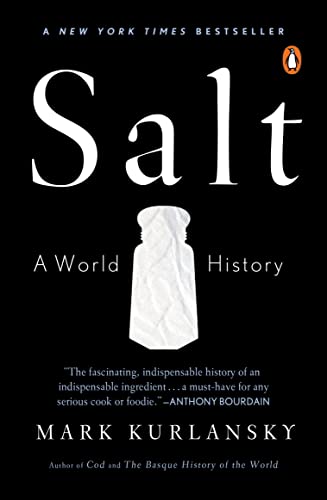
Salt: A World History by Mark Kurlansky

I know it doesn't happen often. But I do occasionally read full length prose novels. I've been trying to make it a point to read 10 pages a day of material related to my chosen degree and teaching field: culinary. I get all sorts of professional training for the teaching part of my job. But I noticed that I wasn't doing much to continue my learning in the culinary field. 

I actually started this book in 2020. I had gotten through about 200 of the 442 pages of this book. And then the pandemic hit and I wanted nothing to do with reading books that weren't fun or escapist in nature. 

After reading a book about the history of the tomato, I decided to dive back into this book by award-winning journalist, Mark Kurlansky. I was a big fan of Kurlansky's 2006 work The Big Oyster; an extensive look at America's obsession with oysters and other types of shellfish. I had seen this work on library shelves previously and had it on my wish list to read some day when I found a used copy for only a buck. 

Salt: A World History is a huge read for a single book devoted to one (and the only) edible rock. From prehistoric day need through the rise of the Greeks and Romans all the way through the American Revolution to the restructuring of global powers after World War I and II, everything you needed to know about salt is in this book. Just about every chapter begins with the process of how a particular civilization gleaned or produced their supply of salt. Then we see how salt was needed to preserve meats and other foods. Finally, we examine the dreaded salt takes and subsequent wars and/or revolutions that came about because stupid politicians decided that filling their coffers were more important that filling the cupboards of the general populace. 

After a couple hundred pages of what feels like the same chapter just with the names and locations switched, the readings got a little boring. Once we got into the last 150 years of history, things changed and the book got rather interesting. Refrigeration ended the need for so much salt. Since cold air could keep your food as fresh as salting it, but with much less effort, the way people prepared foods changed. The need for salt nosedived. As a result, governments that relied on revenue from salt increased the taxes and tariffs imposed on the mineral and people revolted. 

I did not know how vital it was for the Northern forces to destroy the South's ability to produce salt in order to win the Civil War. I had heard Gandhi marched to the sea. But I didn't know that he went there to protest England's ban on even the poorest of Indian citizens from harvesting salt privately. I had no idea about China's ingenious way of using the natural gas found among salt deposits as a way to heat their home, much less to fuel their public bus lines. Plus, I didn't know how the search for salt itself was vital to the discovery of petroleum in Pennsylvania and Texas! There was a ton of fascinating stuff to learn about salt in the modern era of world history. 

I noticed that cod is talked about a lot in this book. That's because about 5 years prior, Kurlansky wrote a historical account of the North Atlantic fish. I'm betting he got a lot of inspiration to write this book from his research on cod. I own that book and I think after I read a couple other culinary related books, to switch things up, I'll be learning more from Mark Kurlansky. 

Salt was interesting. It was also a bit repetitive. I guess there are only so many ways to make the millennial age old process of obtaining salt seem different before you run out of ideas. Definitely a good read. But one that only the most serious of food lover, professionals and scholars are going to enjoy as this is a very complex book on one of the world's most vital resources.

Worth Consuming!

Rating: 7 out of 10 stars.